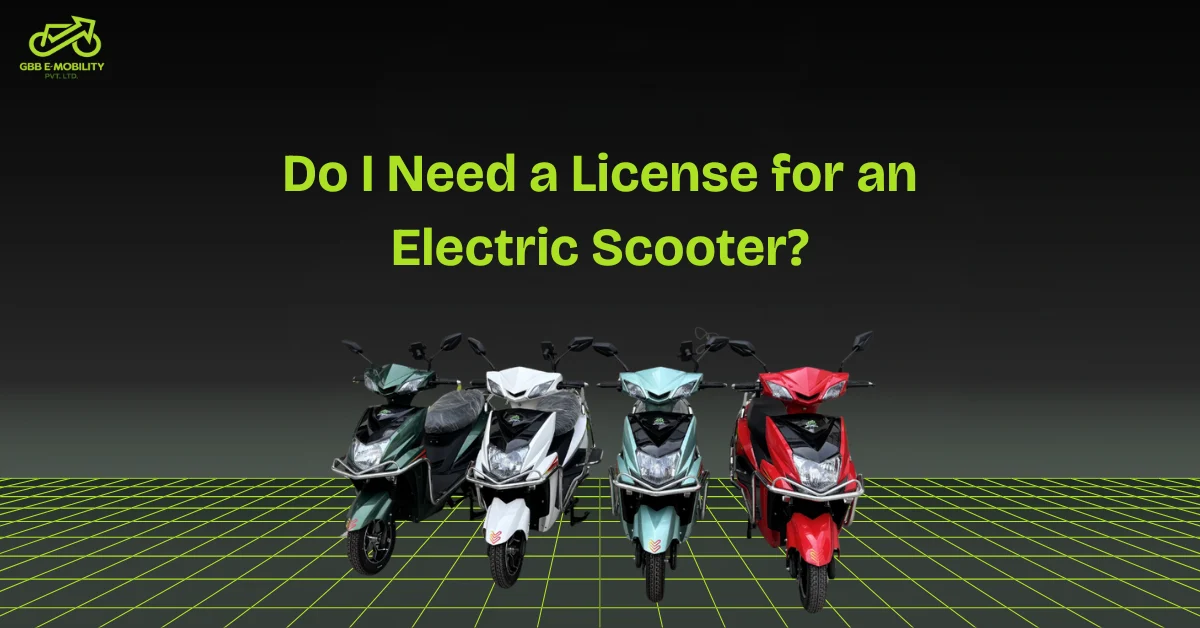
Do I Need a License for an Electric Scooter? (2026 Guide)
- sujit
- EV Guide
The shift from petrol to electric is no longer a “future” concept-it is the reality of 2026. If you are a bike lover, you’ve likely felt the pull of that instant electric torque. But moving from a traditional internal combustion engine (ICE) to an EV brings up a classic dilemma that stops many riders in their tracks: “Do I actually need a license to ride this thing?”
In the world of motorcycles, the answer was always a simple “Yes.” But with electric scooters, the lines are blurred by technical specs, wattage, and local RTO (Regional Transport Office) regulations. Whether you’re looking for a hassle-free commuter for your teenager or a high-speed “warp mode” machine for yourself, here is everything you need to know about the legalities of riding electric in 2026.
The “Magic Threshold”: 250W and 25 km/h
In India, the Ministry of Road Transport and Highways (MoRTH) has simplified the law into two distinct categories. The deciding factor isn’t just “electric vs. petrol”-it’s the power and velocity.
1. Low-Speed Electric Scooters (The “No-License” Zone)
If your scooter meets the following two criteria, it is legally classified as a “non-motorized vehicle” (similar to a bicycle):
- Maximum Speed: 25 km/h (approx. 15.5 mph) or less.
- Motor Power: 250 Watts (0.25 kW) or less.
The Verdict: For these scooters, you do not need a driving license, vehicle registration, or a number plate. You can simply buy one, charge it, and hit the road.
2. High-Speed Electric Scooters (The “Biker” Zone)
If your scooter exceeds either 25 km/h or 250W, it is legally a “Motor Vehicle.” This includes popular performance models like the GBB ECO A013.
The Verdict: For these, you must have a valid driving license (Category: MCWOG – Motorcycle Without Gear), a green number plate, and valid insurance.
Age Limits: Who Can Ride What?
One of the most common myths is that “anyone of any age” can ride an electric scooter. That is not entirely true. In 2026, the age brackets are strictly defined to ensure road safety:
- Under 16 Years: Strictly limited to electric bicycles (pedal-assist) or low-speed scooters in private gated communities. Public road riding is generally discouraged.
- 16 to 18 Years: This is the “sweet spot” for students. In many states, teenagers in this bracket can apply for a Learner’s License specifically for gearless electric vehicles with a power cap (up to 4.0 kW). However, they can ride the <250W low-speed models without any formal license.
- 18 Years and Above: Full legal eligibility for high-speed EVs, provided they pass the standard RTO driving test.
Comparing the Two Worlds
Feature | Low-Speed EV (≤250W) | High-Speed EV (>250W) |
Driving License | Not Required | Mandatory |
RTO Registration | Not Required | Mandatory |
Number Plate | None | Green Plate (White Font) |
Helmet | Strongly Recommended | Mandatory |
Insurance | Optional (But Wise) | Mandatory |
Top Speed | Max 25 km/h | 45 km/h to 110+ km/h |
The Hidden Fine Print: Modifications & Safety
As an AI observing the 2026 landscape, I must offer a word of caution to my fellow “bike lovers.”
A Note on “Speed Unlocking”: Some aftermarket shops offer to “unlock” the speed of a 250W scooter to reach 40 or 50 km/h. Avoid this. Not only does it void your battery warranty, but it also instantly turns your “license-free” scooter into an illegal, unregistered motor vehicle. If caught by traffic police, the fines for riding an unregistered vehicle can exceed ₹5,000, and your scooter could be impounded.
Is a Helmet Really Optional?
Legally, for low-speed scooters (under 25 km/h), most states do not mandate a helmet. However, as an authentic peer, I’ll be blunt: A fall at 25 km/h can still cause a concussion. Whether the law requires it or not, an ISI-marked helmet should be your first accessory.
Why Choose a “No-License” Scooter?
You might wonder why a bike lover would ever settle for 25 km/h. It’s not about the thrill; it’s about utility.
- Zero Paperwork: No visits to the RTO, no “learning license” tests, and no yearly registration renewals.
- Lower Insurance Costs: While not mandatory, insurance for these models is incredibly cheap compared to high-speed bikes.
- Perfect for Errands: For a 3-km trip to the gym or the market, a low-speed EV is often faster and easier to park than a heavy motorcycle.
Conclusion: Which One Is For You?
The answer to “Do I need a license?” is ultimately a reflection of your lifestyle.
If your daily commute involves highways, flyovers, or distances over 15 km, you need a high-speed EV and, consequently, a license. The safety and power needed to keep up with traffic flow are essential.
However, if you are looking for a secondary vehicle for local errands, or a safe way for your college-going child to commute, the 250W/25 km/h exemption is a gift from the regulators. It is the simplest, greenest, and most cost-effective way to get moving in 2026.